The history of Bexhill and St. Barnabas Church
As with all churches, foundation stones are laid because of demand. St. Barnabas is no different, but for context, we should first explore the origins of Bexhill-on-Sea and its growth.
The first reference to Bexhill (Bexelei) was in King Offa's charter in 772 AD, demonstrating a religious community had already been seeded. A manor house built in the 11th century became the Bishop of Chichester's residence and staging house for regional operations of an early diocese.
Interestingly, Queen Elizabeth I took possession in 1561, thus earmarking the foundation of early Bexhill as an important post. Successive owners included Sir Thomas Sackville, Earl of Dorset, and his descendants up to the Earl De La Warr into the 1800s. It was the 7th Earl De La Warr who transformed a small rural village (Old Bexhill Town) into the seaside pleasure resort we know and love today.
The Industrial Revolution and resulting steam engine technology brought a rapidly growing population to Bexhill. An urgent need to house this expanding Christian community gave Leopold Stanley Clarke the will to build our St. Barnabas Church.
In 1876, he was appointed rector of Bexhill. His vision for church life also included the restoration of the parish church, the building of two mission churches, and two schools. St. Mark's and St. Peter's became too small for increasing congregations in the old town, and the new seaside town had no church at all.
In 1889, he donated £6,000 of his own money and, alongside a single acre land donation from the De La Warr family, gave the initial push to begin construction of St. Barnabas Church. A foundation stone was laid in July 1890 by his wife, Mrs Stanley Clarke.
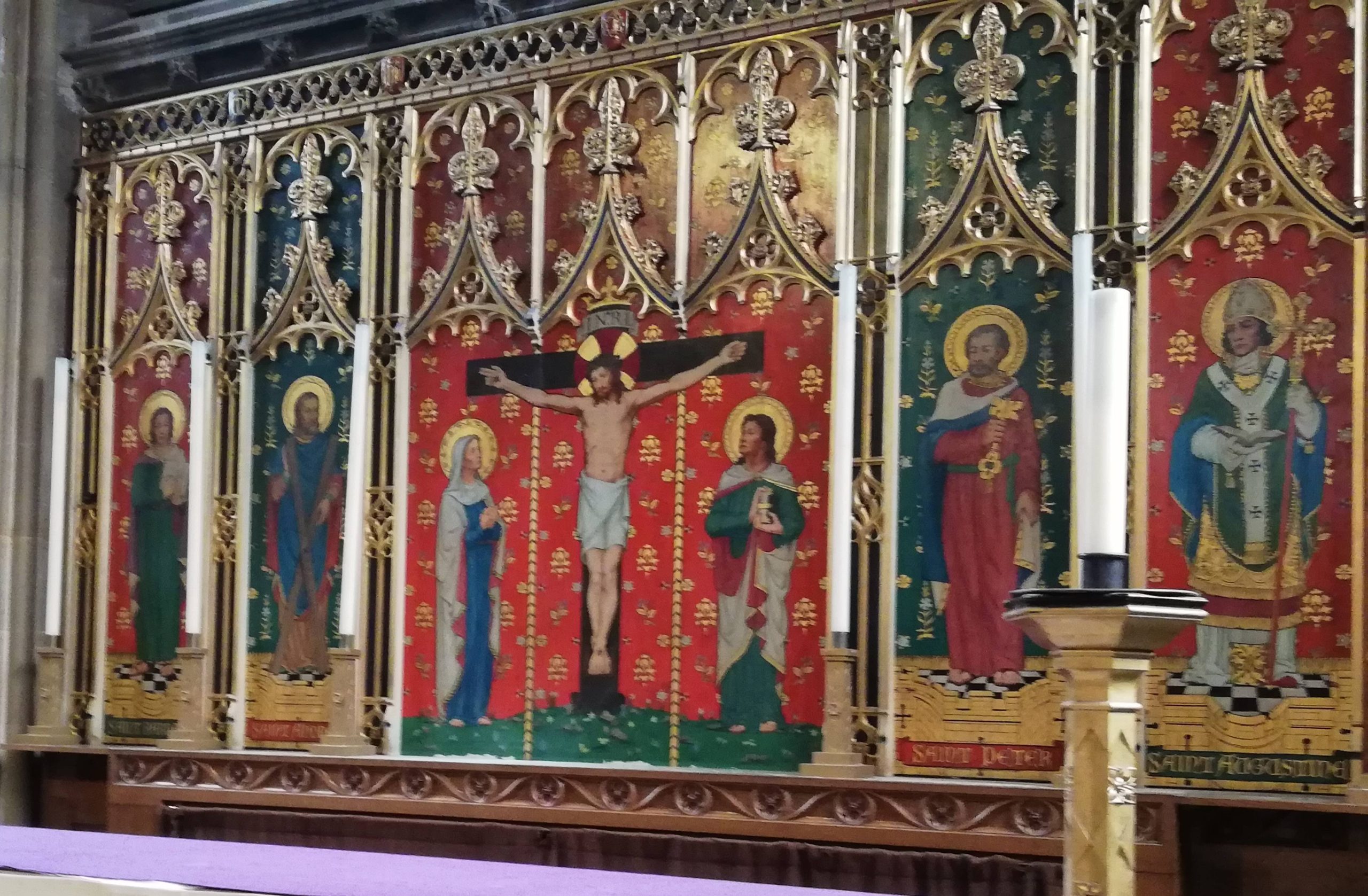
A Lady Chapel like no other. This two-year project depicting The Madonna and Child by local artist Mary Tongue was completed in 1922, taking inspiration from the Italian artist Parmigianino, now celebrated in the National Gallery Collection. Some of her other known works include a stained-glass window for a chapel in France and eight coloured illustrations for a book called The Book of Job. Uniquely, the painting depicts various well-known saints gathered in worship.
Our grand architect
As with all construction projects of this magnitude, the right architect was essential, and this was to be found in Sir Arthur Blomfield, the son of C. J. Blomfield, one of the most eminent Bishops of London. Arthur began his career designing houses, schools, and public buildings in the Classical style. Notably, his works include the Royal School of Music and the Bank of England.
"Work willingly at whatever you do, as though you were working for the Lord rather than for people." — Colossians 3:23
This is why St. Barnabas stands out architecturally from most church buildings. A young Blomfield wanted to make a real statement while setting up his own architectural company. He later went on to build and restore over 200 churches during his career, but later favoured the then-popular Gothic style. Each project was a labour of love. He was often inadequately paid compared to his architectural counterparts, preferring to spend project funds on higher-quality tradespeople. This trade-off can be seen inside St. Barnabas's interior, which is why the church is much loved in the local area.
Blomfield achieved a lot during his lifetime, including becoming President of the Architectural Association, receiving the RIBA Gold Medal in 1891, and being knighted by Queen Victoria.
St. Barnabas Church is a unique example of Victorian architectural splendour, designed to impress, but more importantly, our church was built to unite a growing community in a unifying praise of the Ultimate Architect.
The popularity of seaside towns led to a rise in population from 1,500 to 5,000 by 1905. Leopold Stanley Clarke's vision and determination united the town during this period of rapid expansion. The church became a central hub for everyday life in Bexhill—residents and tourists alike—then as it is today.
Pay us a visit, or learn more about our hire & events here .